Updates from the 2026 Session
This session ran as scheduled, from January 13 to March 13, but without finalized budget negotiations, prompting the need for a special session before July, as well as an additional special redistricting session called by the Governor in April. Overall, fewer bills were passed this year compared to the previous five, though some key early childhood-related bills did pass.
Early Learning Budget Highlights
$1.6 billion for early childhood education, which funds SR and VPK. Which holds steady from FY 2025-2026.
- School Readiness Program - $1.2 billion
- Early Learning Standards & Accountability - $4.9 million
- Voluntary Prekindergarten Program - $431 million
- Summer Bridge Program - $2.8 million
Early Learning Projects Funded:
- Florida Center for Early Childhood Professional Recognition - $5 million
- HIPPY - $3.9 million
- Help Me Grow - $6.5 million
Top Bills We Followed
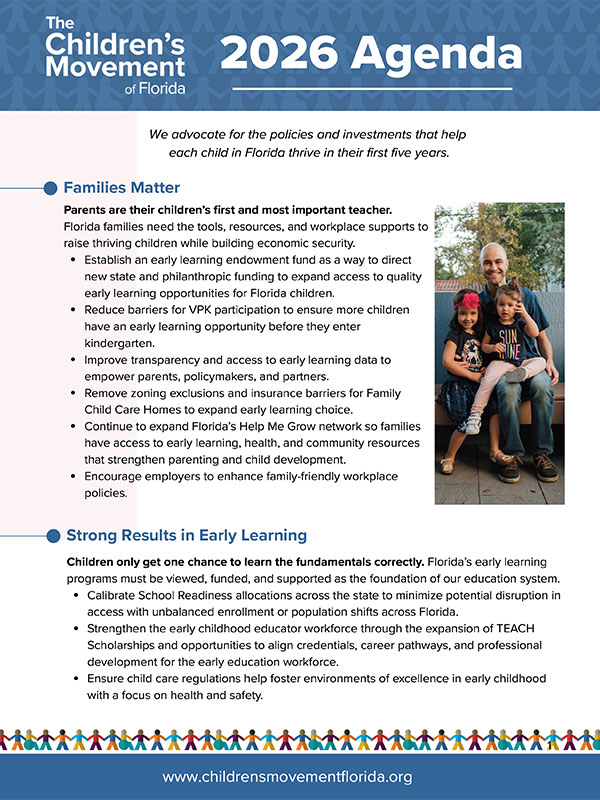
SB 1690 – Early Childhood Education
- Why we followed this bill: It focuses on clarifying child care licensing rules, updating insurance requirements for family child care homes, and adjusting certain administrative responsibilities within the early learning system. It also updates definitions for early care and education facilities, personnel, and family child care homes, including clarifying which before- and after- school programs are subject to licensing requirements. It also replaced the outdated term “family day care” with “family child care” in Florida Statutes—defining “large family child care homes" instead—and provides property insurance protections that prevent insurers from denying coverage solely because the home operates as a family child care program. In addition, the bill expands the Department of Education's direct support organization to include early learning programs and places administration of the Center for Early Childhood Professional Recognition under the TEACH Scholarship Program.
- What happened: The House version, sponsored by Rep. Fiona McFarland, made it through all committees and was replaced with the Senate version, sponsored by Sen. Alexis Calatayud, which passed through all its own committees as well as a Senate floor vote. It was signed into law on June 12, 2026.
- Why we followed this bill: This is a proposal to create a dental therapist position that would provide preventive and restorative care under a collaborative management agreement with dentists. The bill addresses access to dental care by creating a new dental therapist licensure pathway and expanding the settings where Medicaid-reimbursable dental services may be provided, including mobile and community-based locations. The bill aims to increase access to preventive and routine oral health services, particularly for children and underserved communities. Early oral health is closely linked to school readiness, overall health, and long-term outcomes, making this proposal relevant to early childhood well-being.
- What happened: The bill, sponsored by Rep. Chaney, made it through two committees before dying in Rules, its final committee.
HB 515/SB 514 – Doula Support for Healthy Births Pilot Program
- Why we followed this bill: This bill sought to establish a Doula Support for Healthy Births pilot program in Broward, Miami-Dade, and Palm Beach counties. The proposals focus on improving maternal and infant health outcomes during pregnancy and the postpartum period, with an emphasis on populations facing higher health risks. The bills would create a pilot program within the Department of Health to integrate doula services into existing maternal and child health initiatives. The program would serve pregnant and postpartum with prenatal, labor, and postpartum support services designed to reduce preterm births and cesarean deliveries while supporting maternal well-being. In addition, the bills establish a Doula Certification Task Force to review scope of practice, recommend core competencies, and propose minimum certification standards for doulas in Florida. By strengthening access to evidence-based perinatal support during the earliest stages of a child’s life, the proposals aim to improve birth outcomes and support healthy development during a critical period for early learning and long-term well-being.
- What happened: The Senate version, sponsored by Sen. Osgood, made it through its first committee, before dying in Appropriations. Its House companion, sponsored by Rep. Campbell, was not taken up by any committees it was referred to and thus not voted on.
About Florida's Legislative Session
The 2026 Florida Legislative Session officially began on Tuesday, January 13, and ended on Friday, March 13. In the months before session, elected officials laid the groundwork for the 60-day session during their committee weeks.
House and Senate Leadership
Speaker Daniel Perez (R-Miami) and President Ben Albritton (R-Bartow) continued to lead their respective chambers for the second of their two-year terms.
Below are some key leaders in the House who had a say in early childhood issues. You can click on each committee to see if your own elected leaders served on these committees, too.
- Chair Lawrence McClure (R-Dover), Budget Committee
- Chair Jenna Persons-Mulicka (R-Fort Myers), PreK-12 Budget Subcommittee
- Chair Jennifer Canady (R-Lakeland), Education & Employment Committee
- Chair Alex Rizo (R-Miami), Student Academic Success Subcommittee
- Chair Dana Trabulsy (R-Fort Pierce), Education Administration Subcommittee
- Chair Josie Tomkow (R-Polk City), Health & Human Services Committee
- Chair Adam Anderson (R-Palm Harbor), Health Care Facilities & Systems Subcommittee
- Chair Sam Garrison (R-Fleming Island), Rules & Ethics Committee
And in the Senate:
- Chair Ed Hooper (R-Palm Harbor), Committee on Appropriations
- Chair Danny Burgess (R-Zephyrhills), Appropriations Committee on PreK-12 Education
- Chair Jay Trumbull (R-Panama City), Appropriations Committee on Health and Human Services
- Chair Corey Simon (R-Tallahassee), Committee on Education PreK-12
- Chair Colleen Burton (R-Winter Haven), Committee on Health Policy
- Chair Erin Grall (R-Fort Pierce), Committee on Children, Families, and Elder Affairs
- Chair Kathleen Passidomo (R-Naples), Committee on Rules
Committee Weeks
During committee weeks between October 6, 2025, and December 12, 2025, lawmakers began setting priorities for the 2026 Legislative Session, with early learning programs receiving focused attention as part of broader budget discussion. These early conversations, like the December 9 House PreK-12 Budget Subcommittee presentation by Chancellor Cari Miller on the state of early learning helped frame how investments in school readiness, VPK, and related early childhood programs may be discussed as the session begins.
On December 10, 2025, Governor Ron DeSantis released his proposed $117.4 billion budget for Fiscal Year 2026–2027, outlining overall spending priorities for the coming year.
Regular Session: January 13 to March 13
Tuesday, January 13th, 2026 marked the opening of Florida's 128th Regular Legislative Session. Senate President Ben Albritton (R-Wauchula) and Speaker of the House Daniel Perez (R-Miami) delivered remarks in their respective chambers, and Governor DeSantis gave his "State of the State" address to a joint session of the House and Senate.
In his Opening Day remarks, Speaker Perez reflected on the responsibilities of legislative service and the complexity of the issues before the Legislature. He noted that while Florida is an exceptional place to live and work, challenges remain, stating that “our problems are not simple ones, and they can’t be waved away with a magic wand.” He emphasized collaboration and openness as guiding principles for the session, adding that the House stands ready to work “with anyone who is willing to put the needs of our State first,” and underscored the importance of ensuring that “every child in Florida, from the unborn to our college graduates, deserves a fair shot at finding their own American Dream.”
President Albritton focused his remarks on fiscal responsibility, affordability, and the role of the Senate in careful deliberation. He emphasized that Floridians expect stability and balance from state government, noting that “Floridians expect checks and balances, not rash or impulsive decision making.” He highlighted affordability as a key concern for families, stating that the impacts of inflation are “felt by Florida families every single day,” and reaffirmed the Senate’s commitment to balanced budgeting and understanding the long-term consequences of legislative decisions.
Following the Governor’s address, Democratic leaders in both chambers offered responses outlining their priorities for the session. Senate Minority Leader Lori Berman emphasized a focus on affordability, stating that Floridians are seeking solutions that address everyday challenges and improve quality of life. House Minority Leader Fentrice Driskell echoed similar themes, highlighting the importance of addressing cost of living pressures and ensuring that Florida families have meaningful opportunities to succeed.
With Opening Day complete, the Legislature now turns to committee work. Any bill that may pass during the 60 day session has already been filed. The first half of session will focus on committee hearings and policy development, while the latter half will shift toward budget negotiations between the House and Senate and floor consideration of legislation.
Special Session
Florida lawmakers held two back-to-back legislative sessions to finalize the FY 2026-27 state budget and pass a major property tax overhaul that will go before voters as a constitutional amendment in the November ballot.
Looking Ahead
The 2027 Legislative Session is expected to begin on March 2nd.
Updates
Throughout each legislative session, we send weekly updates on early childhood bills filed and moving (or not) through the process. Sign up for our newsletter to receive these updates.
Resources